Bharat Audyogik Vikas Yojna Approved: ₹33,660 Crore Plan to Build 100 Industrial Parks
Thu Mar 19 2026
By Nicho Antony
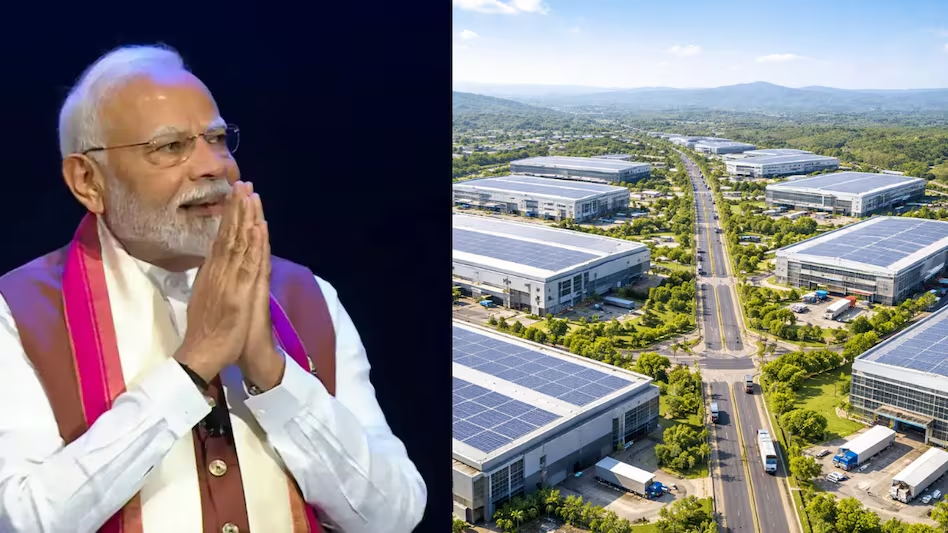
The Government of India has approved a ₹33,660 crore industrial development scheme called BHAVYA (Bharat Audyogik Vikas Yojna), aimed at building 100 world-class plug-and-play industrial parks across the country.
The decision was cleared by the Union Cabinet chaired by Prime Minister Narendra Modi, marking a major push toward strengthening India’s manufacturing ecosystem.
Plug-and-Play Industrial Parks Across India
Under the BHAVYA scheme, industrial parks ranging from 100 to 1,000 acres will be developed through partnerships between:
- Central government
- State governments
- Private sector players
These parks will offer:
- Pre-approved land
- Ready-built infrastructure
- Integrated utilities and services
- Faster setup for manufacturing units
The plug-and-play model enables businesses to move quickly from investment decision to production, significantly reducing delays caused by approvals and construction timelines.
Financial Support and Infrastructure Development
The government will provide financial assistance of up to ₹1 crore per acre for core infrastructure, including:
- Internal roads
- Underground utilities
- Drainage systems
- Administrative buildings
Additional support will be provided for:
- Ready-built factory units
- Testing laboratories
- Warehousing facilities
- Worker housing
Up to 25% of project costs will also be covered for external infrastructure, such as transport connectivity and logistics.
Focus on Ease of Doing Business
A key objective of BHAVYA is to simplify industrial setup by improving ease of doing business.
Key measures include:
- Single-window clearance systems
- Streamlined approval processes
- Reduced bureaucratic delays
These reforms are expected to make India more attractive for both domestic and global manufacturers looking to establish operations quickly.
Building on Existing Industrial Initiatives
The BHAVYA scheme builds on earlier initiatives under the National Industrial Corridor Development Programme, implemented by the National Industrial Corridor Development Corporation (NICDC).
It also aligns with broader national programs such as:
- Production-Linked Incentive (PLI) schemes
- Semiconductor and electronics manufacturing initiatives
- Biopharmaceutical and advanced manufacturing programs
Together, these initiatives aim to create a robust industrial ecosystem across multiple sectors.
Sustainable and Cluster-Based Development
The planned industrial parks will be developed as future-ready ecosystems, incorporating:
- Green energy usage
- Integrated infrastructure systems
- Smart logistics and connectivity
The scheme will follow the PM GatiShakti framework to enhance multimodal connectivity and improve supply chain efficiency.
BHAVYA will also promote cluster-based development, bringing together manufacturers, suppliers, and service providers in a single location to:
- Strengthen supply chains
- Improve productivity
- Reduce operational costs
Economic Impact and Job Creation
The initiative is expected to generate large-scale employment opportunities, including both direct and indirect jobs across:
- Manufacturing
- Logistics
- Infrastructure
- Services
The scheme will be implemented across all states and union territories, ensuring more balanced and inclusive industrial growth nationwide.
Why This Matters
India has long faced challenges in industrial infrastructure, including delays in land acquisition, approvals, and project execution.
BHAVYA addresses these bottlenecks by offering ready-to-use industrial ecosystems, enabling faster investment cycles and reducing entry barriers for manufacturers.
As global supply chains shift and diversify, such infrastructure-led initiatives are critical to attracting large-scale global manufacturing investments.
Looking Ahead
BHAVYA represents a major step in India’s ambition to become a global manufacturing hub.
By combining:
- Infrastructure readiness
- Policy support
- Ease of doing business
the government aims to position India as a preferred destination for large-scale industrial and manufacturing operations.
If successfully implemented, the scheme could significantly accelerate India’s transition into a high-growth, globally competitive manufacturing economy.